Math guide
Sweepstakes Casino Math: RTP, Expected Value, and Playthrough
Published · Updated
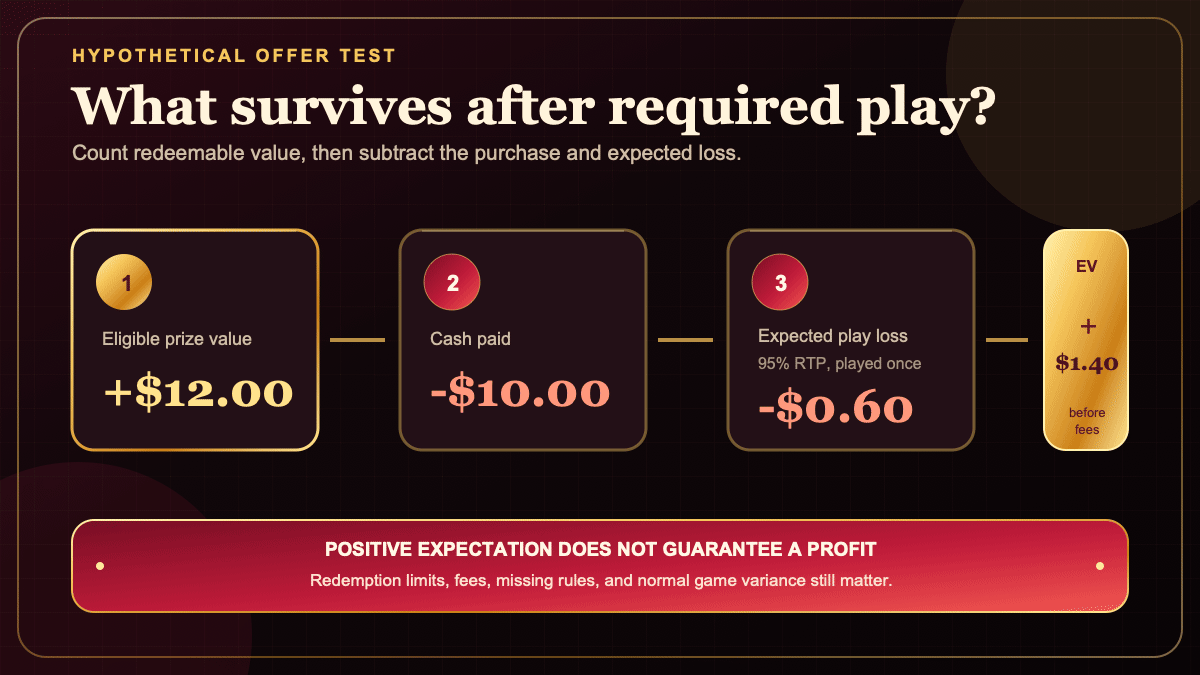
A casino lobby can make a bonus look like free cash. SweepLedger starts with what can actually be redeemed, then subtracts required play and every known cost. The result can identify an offer with positive expected value, but it cannot predict the next spin.
SweepLedger’s “algorithm” filters offers by expected value. It does not tell anyone how to size a bet. A larger bet or a longer session cannot rescue an offer that starts with a negative estimate.
A simple offer calculation
For a first estimate:
estimated offer value = eligible prize value - cash paid - expected play loss - fees
Expected play loss is the required amount played multiplied by the house edge. A game with 95% RTP has a 5% house edge. Use an RTP figure from the current game help file and make sure the promotion allows that game. If the operator does not publish the number, the calculation has a blank. Do not quietly replace it with 100%.
This works much like a grocery coupon. A sign may promise “$3 off,” but the useful number depends on what you must buy, whether you wanted the item, and whether the coupon expires before you use it. The headline is only the starting value.
A worked example with few numbers
Consider a hypothetical offer. The rules say one prize coin redeems for $1, you pay $10, and the package includes 12 eligible prize coins. You must play those 12 coins once through a game with 95% RTP. There is no redemption fee.
The required play is $12 and the house edge is 5%, so the expected play loss is $0.60. The estimate is:
| Part of the offer | Amount |
|---|---|
| Eligible prize value | $12.00 |
| Cash paid | -$10.00 |
| Expected play loss | -$0.60 |
| Estimated value before other costs | $1.40 |
On paper, the offer has a $1.40 positive expectation. This estimate assumes the player can complete the full $12 of required play and redeem the eligible balance that remains. A short session can finish far above or below the average, including at zero.
Now change only the playthrough rule. If the same 12 coins must be played three times, total required play rises to $36. At a 5% house edge, the expected loss becomes $1.80 and the estimated value falls to $0.20 before fees. A $1 redemption fee would turn the estimate negative.
The comparison is similar to driving across town for cheaper gas. The lower pump price may save $2, but the trip is a loss if the extra fuel and tolls cost $3.
RTP is not a win rate
A 95% RTP does not mean 95 out of 100 players win. It describes the theoretical share returned across a large amount of play under the stated rules. The remaining 5% is the house edge.
Two games can have the same RTP and feel completely different. One may return small amounts often, while another may return little for long stretches and occasionally pay a large prize. This spread is volatility.
Think of two routes to work with the same average travel time. One usually takes 30 minutes. The other takes 15 minutes on a clear day and an hour when traffic backs up. The average can match even though the day-to-day experience does not.
Extra play steadily weakens the estimate
Once the required play is complete, every optional wager exposes more money to the house edge. At 95% RTP, another $10 of play carries an expected cost of $0.50. The actual result may be a win or a loss, but the average cost grows with total play.
This is why doubling a bet after a loss does not change the underlying expectation. If each outcome follows the same rules and does not change the next one, changing the bet size only changes how quickly the balance can rise or disappear. It does not change the RTP.
A leaky bucket is a useful picture. Passing the same water through the bucket again does not recover the earlier leak. It gives more water a chance to escape.
Redemption rules belong in the calculation
Prize coins are not cash until the operator accepts a redemption under its rules. Check the minimum balance, eligible games, playthrough, fees, expiry, maximum redemption, state eligibility, and identity requirements.
A balance below the minimum may be stranded. Treat it like an $8 store credit that requires a $20 purchase. It has a printed value, but using it may require more spending. Count that value conservatively unless the existing balance can reach redemption without another purchase.
The same caution applies to AMOE entries. A no-purchase route lowers the cash-paid part of the calculation, but postage and time are still costs. If the rules omit the prize odds, exchange rate, or redemption conditions, there is not enough information to claim a positive expectation.
The SweepLedger value test
- Confirm which coin can be redeemed and its stated redemption rate.
- Record the cash paid and the eligible prize value. Give entertainment coins a cash value of zero.
- Find the required playthrough and the current RTP for an eligible game.
- Estimate the play loss, then subtract fees and any balance likely to remain below the redemption minimum.
- Reject the offer if the result is zero or negative, or if a required input is missing.
- If the estimate is positive, remember that variance can still produce a loss. Complete only the required play and redeem when eligible.
The math proves a limited point. Promotional value can exceed expected play costs, but the game itself still charges an average cost through the house edge. No sequence of bets turns that fixed cost into guaranteed income.
For the coin and redemption rules behind this test, read how sweepstakes casinos work. Apply the same checks to the Rich Sweeps Casino review.
FAQ
Can a sweepstakes casino system guarantee a profit?
No. Expected value describes the average result across many comparable plays. A positive estimate can still lose in one session, and a fixed house edge remains negative during extra play.
Does 95% RTP mean a 95% chance of winning?
No. A 95% RTP describes the theoretical amount returned over a large number of plays under the stated game rules. It does not mean that 95% of players or sessions will finish ahead.
When can an offer have positive expected value?
An offer may have positive expected value when its eligible prize value exceeds the cash paid, expected play loss, fees, and other redemption costs. Missing rules or an unreachable redemption minimum can erase that advantage.